

Journal of International Law and Comparative Studies
Volume 1, Number 2 (2023)
Editor’s Note
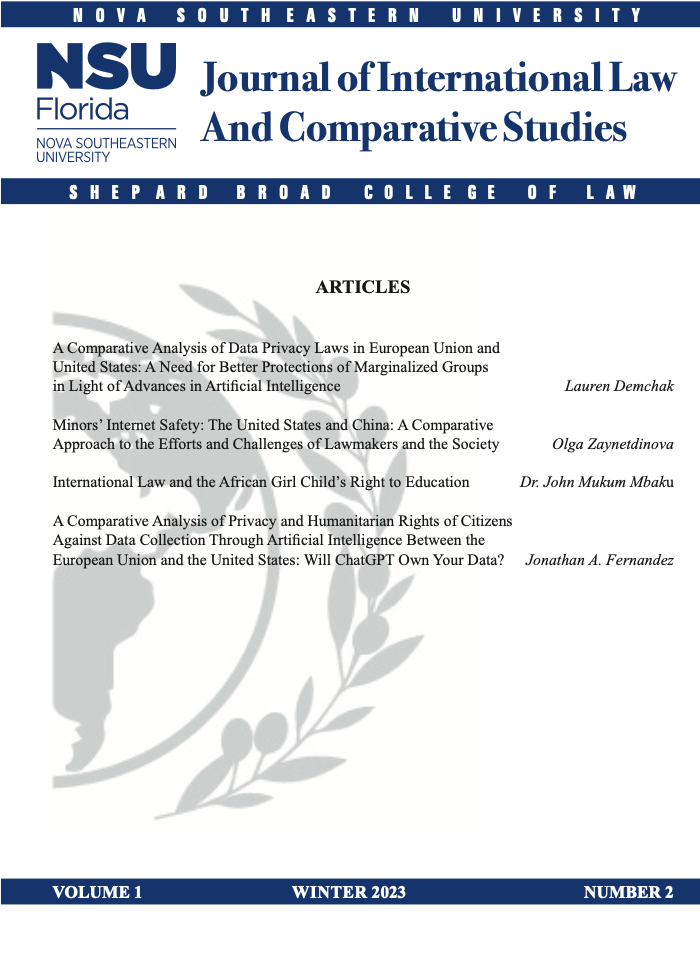
Annually, the Journal of International Law and Comparative Studies publishes three issues. The Journal strives to publish relevant articles that address contemporary legal issues internationally and of significant global importance, with this year’s theme of “A New Age of Regulation: Balancing Personal Privacy and Human Rights in the Digital Era.” Volume 1, Issue 2 focuses on several broad issues that have traditionally impacted the global community, including the need for better protection of marginalized groups with the advances in AI, the safety of the internet with regard to minors, international law and the rights of African girls, and the comparative analysis of human rights with regard to data collection.
This issue begins with the article titled “A Comparative Analysis of Data Privacy Laws in European Union and United States: A Need for Better Protection of Marginalized Groups in Light of Advances in Artificial Intelligence,” written by student Lauren Demchak. Ms. Demchak explains that artificial intelligence (AI) has become ubiquitous globally, empowering machines to mimic human intelligence and impact real or virtual environments through predictions and decisions. While AI holds immense potential for innovation, it also carries inherent risks, particularly concerning biased and discriminatory data that fuels its decision-making processes. This bias perpetuates harmful outcomes across various sectors such as criminal justice, healthcare, migration, and finance, disproportionately affecting marginalized communities. Governments must enact robust regulations to address these concerns, with the European Union leading the way through initiatives such as the Artificial Intelligence Act. Embracing comprehensive regulations worldwide will help ensure the safe and equitable deployment of AI technologies while safeguarding vulnerable populations.
The second article, “Minors’ Internet Safety: The United States and China: A Comparative Approach to the Efforts and Challenges of Lawmakers and the Society,” is written by fellow student Olga Zaynetdinova. Ms. Zaynetdinova’s article analyzes how ensuring minors’ safety in the digital realm is a global priority, prompting nations such as China and the United States to develop distinct strategies for data privacy and security regulation. Despite their differing approaches, both nations acknowledge the crucial need to protect minors’ online experiences. China’s model, while not a template for centralized control, offers valuable insights into reimagining internet regulation for enhanced safety. By examining similarities, differences, and challenges, policymakers can glean valuable lessons to improve minors’ online safety across social media platforms worldwide. As the digital landscape evolves, maintaining a delicate balance between privacy, free speech, and safety remains a complex yet imperative task for the United States.
The third article, “International Law and the African Girl Child’s Right to Education,” is written by Dr. John Mukum Mbaku. Dr. Mbaku’s article addresses the importance of protecting the educational rights of African girls through international law. The article emphasizes the legal and human rights principles that support access to education and highlights the broader need for meaningful protections for vulnerable populations.
The final article, “A Comparative Analysis of Privacy and Humanitarian Rights of Citizens Against Data Collection Through Artificial Intelligence Between the European Union and the United States: Will ChatGPT Own Your Data?” is written by fellow student Jonathan A. Fernandez. Mr. Fernandez discusses how, with continuing technological advancement, confidentiality and data privacy have become increasingly prominent global concerns. In the United States, individuals and states have sought increased protections, often looking to the European Union’s GDPR for guidance. However, much of the legislation remains reactive rather than proactive, underscoring the need for comprehensive laws that empower citizens and regulate companies more effectively. Despite these challenges, growing attention on Capitol Hill signals an increased commitment to addressing privacy concerns and protecting individuals’ rights to their own data.
On behalf of the Journal, I want to thank all the authors for providing us with noteworthy publishable work on unique topics of international law and for working with us throughout this process. I would also like to thank the Junior and Senior Associates for all their hard work in meeting strict deadlines, as well as our Faculty Advisors for their ongoing support and guidance.
Lastly, I want to thank the 2023–2024 Executive and Editorial Boards—Andrew Berlin, Chloe Buikus, Julianna Morgan, Ariana Merinsky, Ancy Jose Varghese, Alexander Brown, and Korinna Cardiff—for their teamwork and commitment to the Journal. To Ancy and Alex, I know how tedious citations can be, but it was your hard work that allowed everything to be completed on time. It is a testament to your work ethic and personality that everyone was able to rely on you in the way that they did. To Chloe, thank you for your work formatting the articles and finding the budget to secure the supplies needed to complete this publication. To Julianna, thank you for identifying the articles selected for publication and for keeping the authors informed throughout the process. To Ariana, thank you for your work with the Bilingual section of the Journal. Your ability to handle that section with little intervention allowed the rest of the Executive Board to focus on other issues. Finally, I want to thank Andrew and Korinna, who kept everything running smoothly and effortlessly. I can honestly say that this publication and all the other work we have done for this Journal would not have been possible without both of you. To the Editorial Board, thank you for your leadership and guidance throughout the semester.
Emily Goldberg
Editor-in-Chief, 2023–2024
Executive Board
Editor-in-Chief
Emily Goldberg
Executive Editor
Andrew Berlin
Managing Editor
Chloe Buikus
Lead Articles Editor
Julianna Morgan
Bilingual Editor
Ariana Merinsky
Lead Technical Editor
Ancy Jose Varghese
Editorial Board
Associate Executive Editor
Korinna Cardiff
Associate Technical Editor
Alexander Brown
Articles Editors
Thalita Saide
Alyssa Rispoli
Ariana Paulino
Mariana Orbegozo