

Journal of International Law and Comparative Studies
Journal of International Law and Comparative Studies is a student-run academic law journal published by Nova Southeastern University Shepard Broad College of Law. The Journal is dedicated to advancing scholarship in international and comparative law by providing a forum for thoughtful analysis of legal issues that transcend national boundaries.
Each annual volume features contributions from legal scholars, practitioners, and law students, offering in-depth discussion of emerging legal developments and comparative perspectives across jurisdictions. Through rigorous editorial standards and careful selection of topics, the Journal seeks to promote meaningful dialogue within the global legal community.
A distinguishing feature of the Journal is its commitment to bilingual publication. Articles are presented in both English and Spanish, expanding accessibility and reflecting the linguistic and cultural diversity of the international legal landscape, particularly within South Florida.
See the Aims and Scope for a complete description of the Journal’s focus and submission criteria.
Current Issue: Volume 2, Number 3 (2024)
Editor’s Note
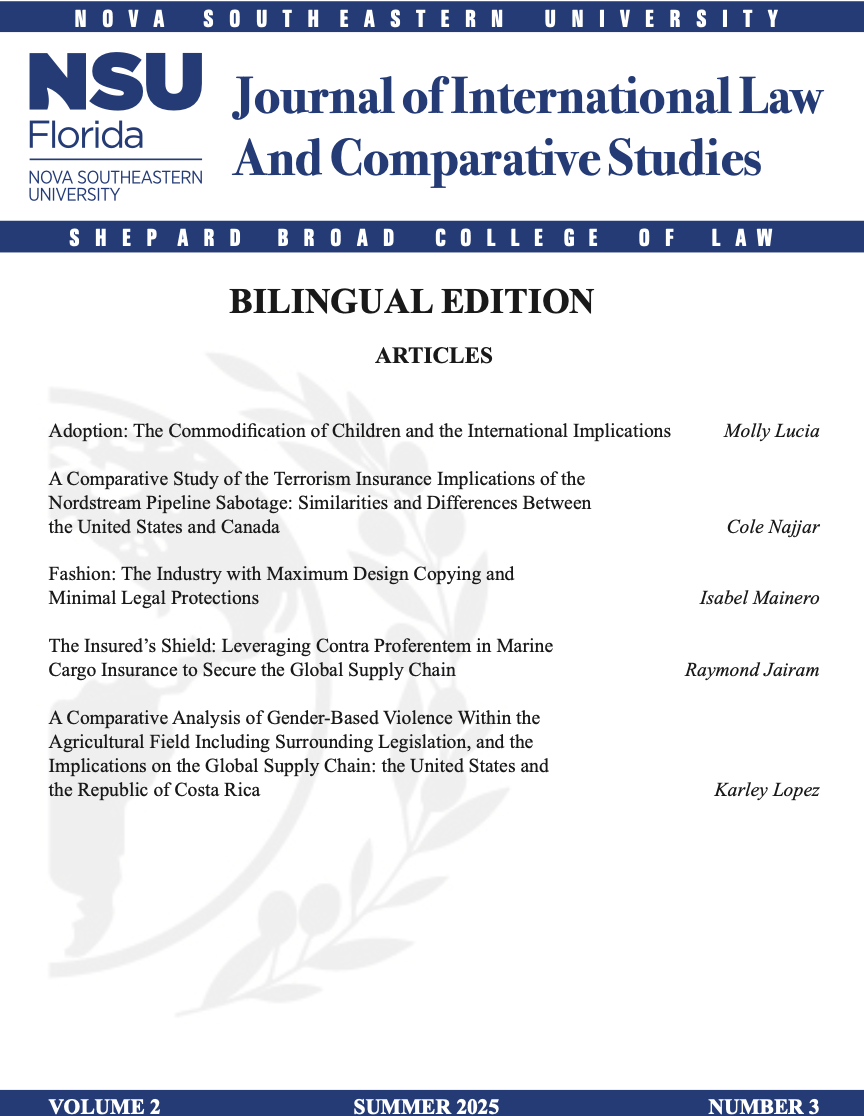
Annually, the Journal of International Law and Comparative Studies publishes three issues. The Journal strives to publish relevant articles that address contemporary legal issues internationally and of significant global importance, with this year’s theme of “International Law and the Global Supply Chain.” Volume 2, Issue 1 highlights several pressing global concerns, examining their legal, economic, and societal dimensions through comparative and international perspectives. Topics explored include the commodification of children in the context of international adoption, the insurance ramifications of terrorism as illustrated by the Nordstream Pipeline sabotage, vulnerabilities within the fashion industry caused by widespread design copying and limited protections, the use of contra proferentem in marine cargo insurance as a safeguard for the global supply chain, and the legal and social implications of gender-based violence within agriculture and its impact on international trade.
The first article, “Adoption: The Commodification of Children and International Implications,” is written by Molly Lucia. Ms. Lucia examines how the international adoption system can transform children into commodities within the global market. By analyzing the intersection of adoption practices, human rights, and international law, she underscores the urgent need for stronger safeguards against exploitation and calls for reforms to protect vulnerable children.
The second article, “A Comparative Study of the Terrorism Insurance Implications of the Nordstream Pipeline Sabotage: Similarities and Differences Between the United States and Canada,” is authored by Cole Najjar. Mr. Najjar discusses how terrorism insurance frameworks are tested by events such as the Nordstream sabotage. While both the United States and Canada recognize the importance of protecting energy infrastructure, their approaches diverge in coverage, regulatory oversight, and risk allocation. This comparison highlights the challenges of addressing large-scale terrorism within the insurance sector.
The third article, “Fashion: The Industry with Maximum Design Copying and Minimal Legal Protections,” by Isabel Mainero, explores the fashion industry’s longstanding struggle with intellectual property law. Ms. Mainero argues that minimal protections against design copying leave creators vulnerable while fueling an industry reliant on rapid trends. By contrasting current legal regimes and their limitations, the article emphasizes the need for stronger international protections that balance creativity, commerce, and consumer demand.
The fourth article, “The Insured’s Shield: Leveraging Contra Proferentem in Marine Cargo Insurance to Secure the Global Supply Chain,” written by Raymond Jairam, focuses on how the doctrine of contra proferentem strengthens policyholders’ rights in disputes with insurers. Mr. Jairam illustrates how applying this principle ensures fairness in contract interpretation and ultimately supports stability in international trade by protecting the movement of goods across borders.
The final article, “A Comparative Analysis of Gender-Based Violence Within the Agricultural Field Including Surrounding Legislation, and the Implications on the Global Supply Chain: the United States and the Republic of Costa Rica,” is authored by Karley Lopez. This article examines how gender-based violence in agriculture extends beyond individual harm, disrupting labor markets and the global supply chain. By comparing the United States and Costa Rica, Ms. Lopez highlights both legal shortcomings and opportunities for reform to address systemic inequalities and strengthen protections for agricultural workers worldwide.
On behalf of the Journal, I would like to thank all the authors for providing us with noteworthy publishable work on unique topics of international law and for working with us throughout this process. I would also like to thank the Junior and Senior Associates for their diligence in meeting strict deadlines, as well as our Faculty Advisors for their ongoing support and guidance.
Lastly, I would like to thank the 2024–2025 Executive and Editorial Boards—Mike Lee, Eric Finkelstein, Alexandra Birk, Dulce Paz, John Lynn, Jan Medina Caraballo, Sommer Sandler, Maxwell Baroody, and Jonathan Fernandez—for their teamwork and commitment to the Journal. To John and Max, I know how tedious citations can be, but it was your hard work that allowed everything to be completed on time. It is a testament to your work ethic and personality that everyone was able to rely on you as they did. To Eric and Sommer, thank you for your work formatting the articles and securing the resources necessary to complete this publication. To Alexandra, thank you for identifying the articles selected for publication and keeping the authors informed throughout the process. To Dulce and Jonathan, thank you for your work with the Bilingual section of the Journal. Your ability to manage that section allowed the rest of the Executive Board to focus on other responsibilities. Finally, I want to thank Mike and Jan, who kept everything running smoothly and efficiently. To the Editorial Board, thank you for your leadership and guidance throughout the semester. This publication would not have been possible without all of your contributions.
Elizabeth Thomas
Editor-in-Chief, 2024–2025
Executive Board
Editor-in-Chief
Elizabeth Thomas
Executive Editor
Muajkoob “Mike” Lee
Lead Articles Editor
Alexandra Birk
Managing Editor
Eric Finkelstein
Bilingual Editor
Dulce Paz
Lead Technical Editor
John Lynn
Editorial Board
Associate Executive Editor
Jan Medina Caraballo
Associate Technical Editor
Maxwell Baroody
Associate Managing Editor
Sommer Sandler
Associate Bilingual Editor
Jonathan Fernandez
Articles Editors
Ansharah Khan
Danielle Engel
Shelly Klein
Sofia Cabrera