

Journal of International Law and Comparative Studies
Volume 1, Number 1 (2023)
Editor’s Note
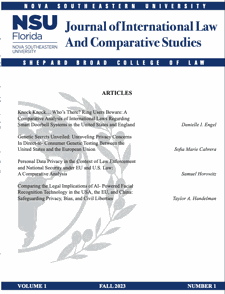
Annually, the Journal of International Law and Comparative Studies publishes three issues. The Journal strives to publish relevant articles that address contemporary legal issues internationally and of significant global importance, with this year’s theme of “A New Age of Regulation: Balancing Personal Privacy and Human Rights in the Digital Era.” Volume 1, Issue 1 focuses on several broad issues that have traditionally impacted the global community, including the effect of smart doorbell systems, privacy concerns regarding consumer genetic testing, ongoing concerns of personal data privacy in the context of law enforcement and national security, and the legal implications of AI-powered facial recognition with respect to privacy, bias, and civil liberties.
This issue begins with the article titled “Knock Knock... Who’s There? Ring Users Beware: A Comparative Analysis of International Laws Regarding Smart Doorbell Systems in the United States and England,” written by Danielle I. Engel. Ms. Engel explains that while smart doorbells offer home protection, they also raise significant privacy concerns, highlighting the blurred line between security and personal freedom. The United States and England diverge in their approaches, with the U.S. relying on private sector surveillance systems amid a lack of clear laws, while England has established comprehensive regulations such as the Data Protection Act 2018 and the UK GDPR. This divergence reflects the broader challenge of balancing constitutional principles with technological advancement.
The second article, “Genetic Secrets Unveiled: Unraveling Privacy Concerns in Direct-to-Consumer Genetic Testing Between the United States and the European Union,” written by Sofia Marie Cabrera, examines the rapid expansion of the direct-to-consumer genetic testing industry. While such testing offers insights into health and ancestry, it also raises serious concerns regarding privacy and data security. With limited regulation, there is an increasing risk of genetic exploitation and unintended disclosure of sensitive information. The article emphasizes the need for updated legal frameworks in both the United States and the European Union to balance innovation with the protection of individual genetic data.
The third article, “Personal Data Privacy in the Context of Law Enforcement and National Security under EU and U.S. Law: A Comparative Analysis,” by Samuel Horowitz, explores the differences in how the European Union and the United States approach data privacy. Despite the EU’s stringent privacy protections, uncertainties remain regarding individual rights in law enforcement and national security contexts. Conversely, the U.S. lacks similarly robust constraints, particularly for non-citizens. The article highlights how cross-border information sharing presents ongoing challenges to protecting personal data.
The final article, “Comparing the Legal Implications of AI-Powered Facial Recognition Technology in the USA, the EU, and China: Safeguarding Privacy, Bias, and Civil Liberties,” by Taylor A. Handleman, discusses the global rise of facial recognition technology. While the United States exhibits a fragmented regulatory landscape, the European Union provides stronger privacy protections through the GDPR, and China’s centralized approach enables rapid technological advancement but raises concerns regarding surveillance and misuse. The article underscores the importance of global cooperation to establish consistent privacy standards.
On behalf of the Journal, I would like to thank all the authors for their noteworthy contributions and for their collaboration throughout the publication process. I also extend my gratitude to the Junior and Senior Associates for their diligence in meeting strict deadlines, and to our Faculty Advisors for their continued support and guidance.
Lastly, I would like to thank the 2023–2024 Executive and Editorial Boards—Andrew Berlin, Chloe Buikus, Julianna Morgan, Ariana Merinsky, Ancy Jose Varghese, Alexander Brown, and Korinna Cardiff—for their teamwork and dedication to the Journal. Your collective efforts made this publication possible, and your commitment to excellence is deeply appreciated.
Emily Goldberg
Editor-in-Chief, 2023–2024
Executive Board
Editor-in-Chief
Emily Goldberg
Executive Editor
Andrew Berlin
Managing Editor
Chloe Buikus
Lead Articles Editor
Julianna Morgan
Bilingual Editor
Ariana Merinsky
Lead Technical Editor
Ancy Jose Varghese
Editorial Board
Associate Executive Editor
Korinna Cardiff
Associate Technical Editor
Alexander Brown
Articles Editors
Thalita Saide
Alyssa Rispoli
Ariana Paulino
Mariana Orbegozo