


Files
Submission Date
Fall 2025
Abstract
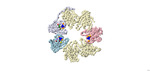
This project aims to model and observe the binding of the drug Marizomib (MZB) and compare its binding affinity to that of other similar drugs to the proteosome using the available PDB ID 9HMN and bioinformatics tools. MZB is an anti-cancer drug that was derived from the marine bacterium, Salinosporamide A. Its function is to inhibit the human 20S proteasome from breaking down misfolded and excess proteins, which eventually causes the cell to trigger apoptosis. Additionally, MZB has a unique ability to cross the blood-brain barrier and utilize three catalytically active amino acid sites. The existing PDB ID (9HMN) of a 20S proteasome with MZB bound was 3D printed. The catalytically inactive alpha subunits and one beta ring was removed to better model the three active beta sites. The catalytically active subunits, important binding residues, and the MZB drug were then color coded. To compare the binding of MZB to that of the similar drug Carfilzomib (CFZ), we used SwissDock to isolate the beta-5 subunit and dock Carfilzomib in the area where MZB typically binds. It was concluded that MZB and CFZ have similar binding regions of the beta-5 subunit, though at different residues. The MZB binding has greater affinity for the β1, β2, and β5 subunits, while the CFZ binds only to the β5-subunit site. It was determined that MZB specifically bound to the three catalytic “conserved triad” residues (Thr1, Asp17, and Lys33) on each of the three subunits. Further binding residues for MZB include Gly47, Thr21 and Ser130 for main and side chain interactions, and Ser129, Asp166, and Ser169 for structural integrity. Based on the locations where the drug binds, the MZB drug shows the highest affinities for the subunits and thus has the greatest applications for cancer treatments. The process of modeling the proteasome inhibitor MZB and the use of a 3D printed model helps illustrate its potential for cancer treatments (including glioblastoma and myeloma). MZB can bind to all three of the catalytically active subunits within the beta-ring of the proteasome, which is something that the other drugs we investigated cannot do effectively. Furthermore, MZB is stabilized within the active site by binding to the conserved triad and other residues for structural integrity.
Recommended Citation
Ross, Jayden J.; Medina, Giezel; Anand, Audrey; Ari, Jayant; Schmitt, Emily; and Sikora, Arthur, "Modeling the Binding of Salinosporamide A (MZB) to the Human 20S Proteasome for Potential Cancer Treatment" (2025). Protein Modeling Reports. 22.
https://nsuworks.nova.edu/protein_modeling_reports/22
Proteasome Jmol Script
Final Poster - Group 1.pdf (578 kB)
MZB and Proteasome Poster Presentation