

Preview
Description
Josignacio is one of the most significant figures in contemporary art to emerge from Latin America in the late 20th century. He is known for creating the Plastic Paint Medium, becoming the first artist globally to paint entirely with pigment-mixed melted resin inspired by the Abstract Expressionist (AbEx) New York School. Aesthetically, his work is noted for using the Plastic Paint Medium to syncretize most of the major Contemporary movements of the preceding century, including AbEx, Pop Art, and Neo-Expressionism/Postmodernism with layered conceptual and narrative-symbolic elements.
His early artistic development was marked by both early achievements and significant interference from the Cuban government for perceived lack of support of the Castro regime. This including being blocked from attending art school and later having a public commission for the Havana Carnival reassigned to another artist. Despite his lack of formal education and institutional support, Josignacio received direct training from many of Cuba’s leading artists who would frequently visit his family home, including René Portocarrero, Mariano Rodriguez, Antonia Eiriz, and Raul Milián. Before solidifying his artistic stature with the Plastic Paint Medium, Josignacio also received significant early attention for winning awards and exhibiting in several of the country’s leading galleries. Ultimately, however, his repeated struggles with the Cuban government culminated in his invitation to exhibit internationally in two major venues in Mexico City—The Gallery of the National Auditorium and Centro Cultural Los Talleres in Coyoacán—being suddenly revoked by the Cuban Embassy in Mexico, leading him to leave Cuba for the United States on September 14, 1989.
Since relocating to the United States, Josigancio quickly participated in art auction and secured representation form leading art galleries. In 1996 he won South Florida’s oldest and most prestigious art award, the Hortt Prize Best In Show, bringing him national and eventually international recognition. This has has included attracting multiple prominent collectors, such as former U.S. President Bill Clinton, the Bill Gates Foundation, the Bacardi Family, as well as celebrities Madonna, Beyoncé, Gloria Estefan, and Andy Garcia.
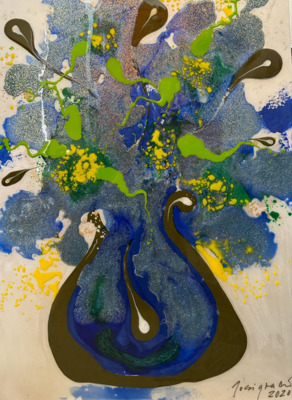
In 2016 he set the global record in London for highest price ever reached at auction by a Living Latin American artist with a hammer price of $3,480,000. He is included in the permanent collection of the Tampa Museum of Art, the Wilzig Museum in Miami Beach, the Jumex Museum in Mexico City, and the National Library of Cuba. This piece is from his series of florals, titled Flores meae numquam marcescun —My flowers never wilt, one of the longest running of his career and predates his development of the Plastic Paint Medium. The series began in the early 1970s when he was then being mentored frequently by Cuban painter Felipe Lopez who had taught him methods to best mix colors as well as color theory. During this period Lopez had advised Josigancio that the best way to find new subtle and exact color variations was to find, study, and replicate flowers of different colors and paint them from life rather than images. With this he began the series, initially resulting in lifelike, hyper realist still lifes.
While his floral works are now executed in his recognizable and established style within the Plastic Paint Medium, they remain a bold expression of color. They also represent a bridge of continuity from his upbringing in Cuba to his international success upon relocating to the United States. This specific piece, Vase of Flowers, was created during the COVID-19 Pandemic and shows influence of his mentor Portocarrero, as well as Americans Jackson Pollock and Georgia O’Keeffe. He also used it to communicate a complex range of emotions and ideas. On the surface, it primarily represents an expression of hope, life, and a symbolic flourishing from within that, despite being contained in a vase, remaines connected to the natural world and universe at large. This is seen in outsized perspective of the petals, the bursting imagery arising from the vase, as well as the interstellar imagery that he has implied through the use of iridescent sparkling paint, which changes in hue based on the perspective of the viewer.
Despite this, Josignacio also acknowledges the starkness of that period in time by avoiding his typical colorfield backgrounds and replacing it with a comparatively minimalist, predominantly white background. This represents an atmosphere of numbness, sterility, and lack of definition from which the piece emerged. In addition to conceptually contrasting hope within starkness, the choice for a white background also visually enhances the focus given to the flowers depicted.
Finally, here Josignacio pushes the limits of the boundary between abstraction and figuration by refusing to delineate the individual flower petals, allowing only the flower pestle to serve as the sole visual guides to indicate the number of flowers depicted while the petals themselves merge into a largely amorphous and ambiguous cloud erupting from the within the vase, suggesting volcanic imagery and hinting to further elements of the artist’s mindset during its creation.
Date Digital
2-2-2026
Date Original
2020
Format
Plastic Paint Medium on Canvas