

Preview
Description
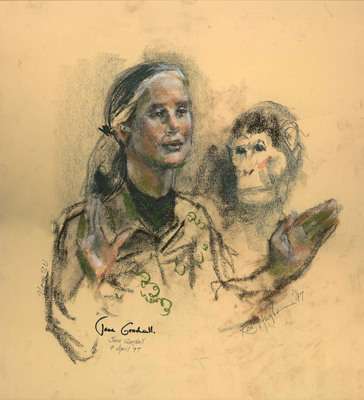
Dr. Jane Goodall (April 3, 1934 – October 1, 2025) was a legendary British primatologist, ethologist, and conservationist whose pioneering research fundamentally altered humanity's understanding of animals. Raised in England with a profound childhood love for wildlife, she traveled to Kenya at age 23. There, she met the famed paleoanthropologist Dr. Louis Leakey (1903–1972), who chose her for a unique assignment: to study wild chimpanzees in their natural habitat. In 1960, she arrived at what is now Gombe Stream National Park in Tanzania to begin her historic fieldwork. (Sources: National Geographic Society, Encyclopædia Britannica) Despite having no formal scientific degree at the outset of her research, Goodall's patient, immersive observation style yielded immediate, revolutionary insights. Her most celebrated breakthrough occurred when she witnessed chimpanzees crafting and using simple stick tools to extract termites from mounds—proving that humans were not the only species capable of tool manufacturing. Her long-term studies further revealed that chimpanzees exhibit complex emotional lives, distinct personalities, hunting behaviors, and deep social bonds. She later earned a Ph.D. in ethology from the University of Cambridge, becoming one of the few researchers admitted to a doctoral program without an undergraduate degree. (Sources: Encyclopædia Britannica, NPR) As threats to wildlife habitats escalated, Goodall pivoted from field research to full-time global activism. In 1977, she founded the Jane Goodall Institute to promote community-centered conservation and habitat protection. Dedicated to mentoring future generations, she established Roots & Shoots in 1991, an international youth-led initiative focused on community and environmental service. Over her multi-decade career, she served as a United Nations Messenger of Peace, was appointed a Dame Commander of the Order of the British Empire (DBE), and received numerous international honors, including the Templeton Prize and the U.S. Presidential Medal of Freedom. Goodall traveled extensively well into her nineties, serving as a global voice for biodiversity, environmental stewardship, and hope until her peaceful passing at the age of 91. (Sources: Jane Goodall Institute, NPR)
Date Digital
2015-04-15
Format
Pastel drawing
Digital Collection
Forum
Repository
NSU Archives, Nova Southeastern University
Disciplines
Animal Sciences | Animal Studies | Anthropology | Biological and Physical Anthropology | Biology | Education | Life Sciences | Social and Behavioral Sciences | Zoology
Rights
Educational use only, no other permissions given. U.S. and international copyright laws may protect this item. Commercial use or distribution of this digital object is not permitted without written permission of the Nova Southeastern University Archives.
Copyright
Efforts by Nova Southeastern University Archives to locate an heir of the creator or a holder of the copyright to the materials were unsuccessful. If you know of a verifiable copyright holder for this item or if you have any question regarding the publication rights, please contact the Nova Southeastern University Archives.
Digitization Specifications
Scanned from a photographic print using a EPSON Perfection V700 Photo Scanner at 600 dpi in Tiff format
Keywords
animals, biodiversity, chimpanzees, conservationist, Dame Commander of the Order of the British Empire (DBE), Distinguished Speakers Series, doctoral program, emotional lives, environmental service, environmental stewardship, ethologist, Executive Council Forum, fieldwork, Forum Series, global activism, Gombe Stream National Park, habitat, hunting behaviors, insights, Jane Goodall Institute, Kenya, Louis Leakey, National Geographic Society, Nova Southeastern University, observation, personalities, Ph.D., primatologist, research, Roots & Shoots, social bonds, Tanzania, Templeton Prize, tool manufacturing, U.S. Presidential Medal of Freedom, undergraduate degree, United Nations Messenger of Peace, University of Cambridge, wildlife, youth-led initiative